
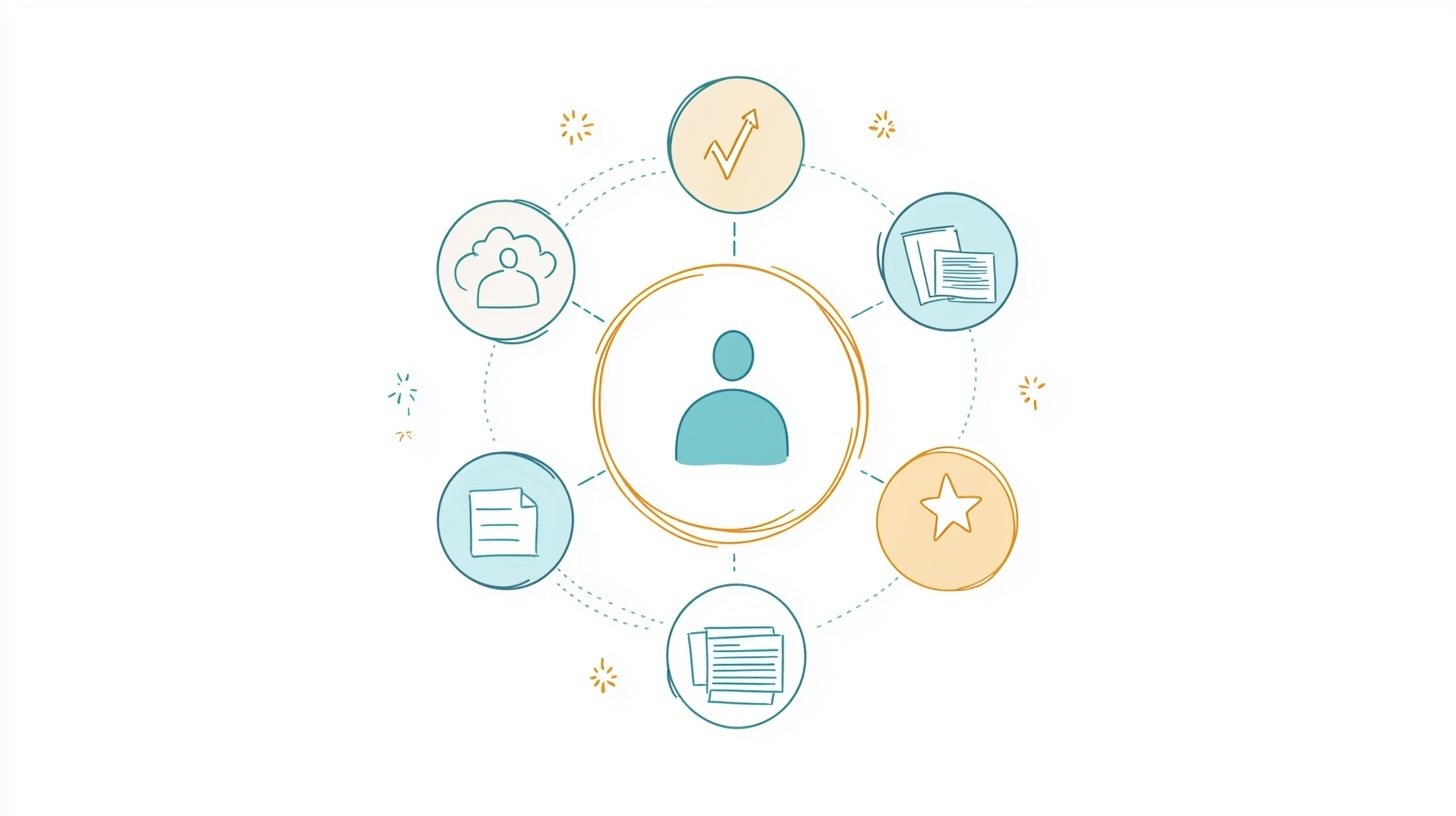
In Part 1, Fluid Design: The Next Evolution in Instructional Design made the case that simulation-based learning is where the profession is heading, and that sequential design processes can't support it. This part addresses the practical question: what does it actually look like to design this way, and what makes it executable?
The answer starts with a different kind of simulation than the field has built before.
Microworlds: A Practical Evolution of Simulation
Simulations themselves are not new. What is new is that AI makes them practical to build and engaging to experience.
AI allows simulations to move beyond static scenarios and pre-scripted paths. Storylines can evolve. Characters can respond dynamically. Context can shift based on learner behavior. These capabilities were once expensive to build and difficult to maintain. They are now achievable.
We refer to this new class of simulation as microworlds. We adopted the term 'microworld' from Seymour Papert (Papert, 1980), who used it to describe learning environments where complex principles become directly experienceable. Papert understood that people don't learn systems thinking by studying systems; they learn by inhabiting systems where their actions have consequences they must interpret.
A microworld is a compressed version of reality. It captures the essential dynamics of a role or situation and allows learners to practice within it. A leader engages in a difficult feedback conversation with an AI employee while addressing a budget conversation with her boss. An account manager navigates competing priorities across multiple stakeholders, each represented by an AI character with distinct motivations and constraints. A new manager decides which tasks to delegate and to whom, then watches how those choices shape team trust, capability, and morale over time. The world reacts not only to what you decide, but how you decide and who you are becoming. That's what microworlds enable: not just simulated practice, but genuine participation in a compressed reality.
But participation alone doesn't produce learning. Two elements make microworlds particularly powerful. The first is an AI tutor with complete visibility into the learner's journey. Unlike traditional coaching that relies on self-reporting or observation of isolated moments, this tutor is trained on the entire simulation: the content, the storyline, every decision, every score, and every conversation the learner has with AI characters. This comprehensive view allows feedback that is genuinely personalized, not generic advice, but specific observations tied to what the learner actually did and why it mattered.
The second is an AI-powered subject-matter expert. During the design process, real SMEs are interviewed, and their stories, demeanor, and experience are captured. These come to life within the microworld. When a learner struggles or succeeds, the SME can share relevant wisdom from someone who has been there. It's the difference between reading a best practice and hearing a veteran say, 'Here's what I learned when I faced the same situation.'
Only a few years ago, experiences like this would have taken months to build and required significant investment. Today, they are achievable in days.
SimGate: Agentic AI Platform for Creating Simulations
SimGate is where Fluid Design becomes practical. Designers move fluidly between analysis, design, development, deployment, and analytics while agentic AI handles the mechanical work. The result is a practical way to design, test, and refine simulation-based microworlds faster than traditional tools allow, without giving up the instructional judgment that makes the work worth doing.
At the center of SimGate is an AI Design Agent that functions like a capable designer: it can research, draft, and check for gaps, but it looks to you for direction and judgment. As you move between spaces, it keeps pace, surfacing relevant research, flagging potential gaps, and asking questions that help sharpen your thinking.
Within SimGate, designers navigate three interconnected areas called Design Spaces:
• Fusion Space is where you synthesize knowledge
• Generation Space is where you create and refine the experience
• Collaboration Space is where you evaluate and guide the design
All three spaces operate simultaneously. You don't complete one before moving to the next.
Think of it like a master chef's kitchen. A master chef doesn't stand at one station cooking everything personally. Their kitchen has specialized stations: prep, saute, grill, pastry, and plating. Each station has skilled cooks handling the chopping, searing, and reducing. The chef moves between them, tasting a sauce, adjusting seasoning, checking timing at one station while calling out directions to another.
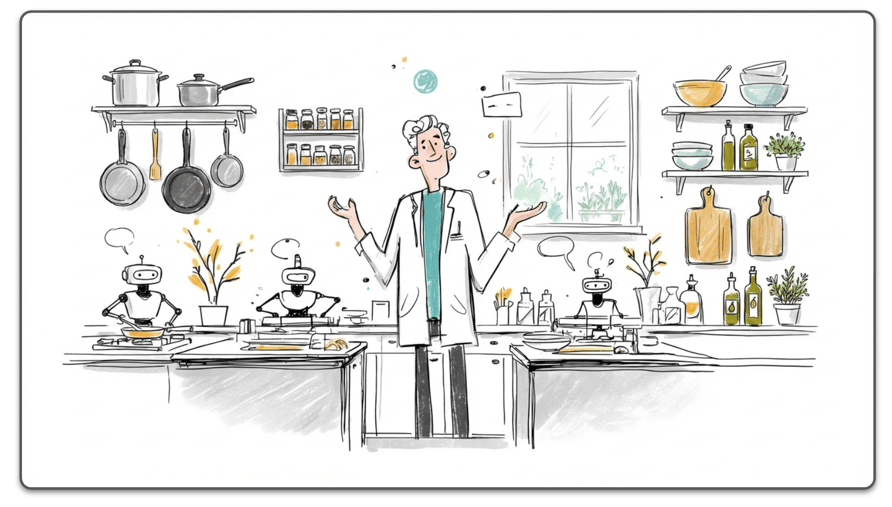
The chef isn't doing the grunt work. They know which station needs attention, when something's off, and how the timing has to align so every dish lands together. The cooks bring skill and execution. The chef brings taste, vision, and the ability to see how everything on the plate connects.
Fluid Design works the same way. Each Design Space is staffed with specialized AI agents: researchers, developers, and assessment experts. Need research synthesized? Direct the agent. Need content organized? Point it to the sources. Need assessments created? Describe what you want to measure. The designer moves between spaces, adjusting what isn't right, calling the next move based on what the learning experience actually needs. The AI agents handle the prep and execution. The designer shapes the experience, makes the calls, and brings it all together.
A Designer in Motion
What does this look like in practice? Here is an example.
Sarah is designing a leadership simulation for new managers. She opens SimGate and starts in Fusion Space. She drops in three sources: an interview transcript from a senior vice president, a set of business outcomes she had worked out with her stakeholders, and two examples of common failure patterns in first-year managers. The AI agents synthesize across all three and generate a set of additional interview questions to deepen her understanding of the problem, and a course briefing — a concise overview of the experience's intent and outcomes that she can share with stakeholders before development goes further.
Realizing she needs more input before building, she asks an AI Interview Agent to conduct a dozen 15-minute interviews with current managers. While those are running in the background, she shifts into Generation Space and generates a quick prototype to review with the senior vice president. When she returns to Fusion Space, several of the interviews are already complete — synthesized and organized into a skill graph that maps what the interviews revealed about where new managers actually struggle.
She updates the prototype based on what the skill graph revealed and sends a link to a few stakeholders to review. One responds that seeing it all put together helped her understand the activities and the depth of thinking participants would experience — enough to feel confident that more content wasn't needed. Two others request some adjustments to the learning objectives and a new section tied to an additional outcome. Sarah makes the changes, asks the Generation Space agents to regenerate the prototype, and within minutes has an updated version ready.
Now ready for the next round, she asks the Generation Space agents to build out the scoring and modifies some of the feedback before sending a link to a small group of managers to experience. They find problems. A few areas feel underdeveloped. But considering the entire process to reach that feedback took less than a week, Sarah is more than happy to make the changes, update the briefing and skill graph, and regenerate the prototype for another round.
Fluid Does Not Mean Unmanaged
Notice what Sarah's stakeholders were doing throughout that process. They weren't approving documents. They weren't signing off on storyboards that described an experience they couldn't quite picture. They were playing a prototype, watching how it felt, and telling her exactly what needed to change. That's a different kind of oversight. Not lighter. More honest.
Governance doesn't disappear in Fluid Design. It shows up differently. Risk, compliance, and quality assurance still matter. What changes is when they happen and what they're based on. Instead of a review gate at the end of each phase, feedback runs continuously, tied to something real. Stakeholders stay informed because they can see the work, not because they approved a plan that described it.
What Stakeholders See
Sarah's experience describes what Fluid Design feels like from the inside. But there's another perspective worth considering: what her stakeholders saw.
In the first week, they had a course briefing and a working prototype. They had already reviewed it, weighed in, and watched their feedback show up in the next version. A group of managers had experienced it and responded. None of that came from a status meeting or a progress report. It came from the work itself.
For stakeholders who are used to signing off on documents and waiting months to see results, that experience lands differently. They aren't being asked to trust a plan. They can see what is being built, shape it as it develops, and feel confident that what gets deployed reflects their input. That confidence is hard to build through process alone. It comes from being involved in something real.
For a CLO managing a portfolio of learning initiatives, the shift is equally significant. Decisions about scope, priority, and investment can be made against evidence rather than estimates. And when the business asks how capability development is going, the answer isn't a timeline. It's a prototype someone can play.
 That shift from reporting on process to demonstrating progress is one of the quieter benefits of Fluid Design. It doesn't show up in a methodology. It shows up in the conversation between L&D and the business, and in how much that conversation has changed.
The Path Forward
What SimGate and microworlds make possible, taken together, is a different relationship between learning design and organizational performance. Instead of delivering content and hoping behavior changes, designers can create experiences where performance is practiced, observed, and validated. Instead of long design cycles that produce something untestable until the end, they can produce working prototypes early and refine them based on evidence. Instead of defending a process, they can stand behind the quality of what learners can actually do when the experience is finished.
For designers, this is not a narrower role. The strategic thinking, the scenario craft, the judgment about what a learner actually needs in a given moment — none of that is automated. What changes is the cost of execution and the speed of iteration. Designers who develop fluency in this way of working will find themselves doing more consequential work, with clearer results, in less time.
That is what the profession has always been trying to do. The tools have finally caught up.
Mike Vaughan is the CEO of The Regis Company and Editor in Chief of The Thinking Effect, bringing over 30 years of experience at the intersection of AI, cognitive neuroscience, and experiential learning, including a Master's in Cognitive Neuroscience from Middlesex University, London. He is the author of The Thinking Effect and the architect of SimGate, the first AI-enabled Skill Practice Platform designed to make simulation-based learning scalable for any organization.