
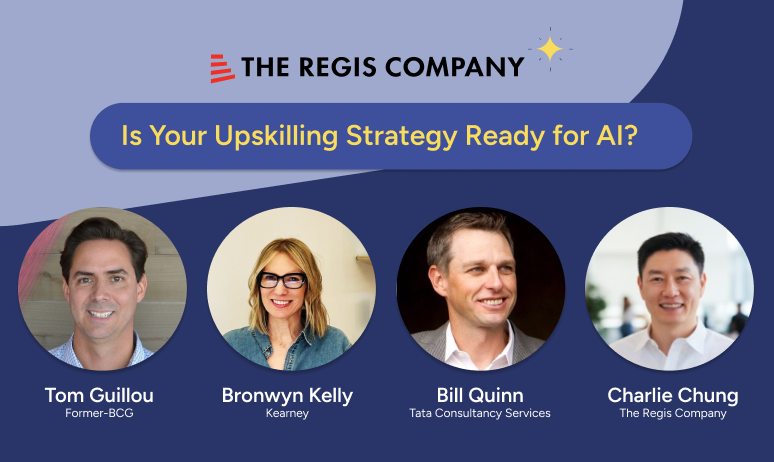
In professional services, where expertise is the product and intellectual capital drives competitive advantage, the arrival of AI isn't just disrupting workflows, it's fundamentally redefining what human value means. On December 9th, senior learning leaders from Kearney, Boston Consulting Group, and Tata Consultancy Services gathered to share what they're actually experiencing on the ground as they navigate this transformation.
The conversation, moderated by Charlie Chung (VP Sales, The Regis Company), moved beyond platitudes about "AI changing everything" to the practical realities of building AI-augmented workforces while strengthening the human capabilities that maintain client value.
Meet the Panel: Experience from the Front Lines
Bronwyn Kelly, Chief Learning Officer and VP of Global Learning at Kearney, brings perspective from a firm where consultants must now balance traditional strategic thinking with AI-enabled productivity tools—all while maintaining the judgment and client relationship skills that define consulting excellence.
Tom Guillou, former Senior Director of Global Learning Technology, Innovation, and Analytics at Boston Consulting Group, shared insights from years of transforming learning at scale in a firm known for both intellectual rigor and technological sophistication.
Bill Quinn, Futurist and Strategic Advisor at Tata Consultancy Services, offered the strategic advisor's view on what happens when entire industries shift their mental models about how work gets done.
Together, these leaders represent organizations collectively employing hundreds of thousands of knowledge workers—all grappling with the same fundamental question: how do we develop people when the skills landscape is shifting beneath our feet?
The Mental Model Shift: Stop Asking Google, Start Asking AI
Perhaps the most memorable insight came from Bill Quinn, who challenges organizations to make a deceptively simple change: "Go a week - or even a month - and don't use Google at all. Whatever you were going to ask Google, just ask AI instead."
This isn't about technology adoption. It's about fundamentally shifting how we approach knowledge work. As Bill explained, when you force yourself to use AI as your primary interface for information and problem-solving, you quickly discover not just what AI can do, but how your own thinking needs to evolve to leverage it effectively.
The exercise reveals a profound truth: AI isn't just a better search engine. It's a thinking partner that requires us to develop new patterns of collaboration, questioning, and synthesis. Organizations that treat AI adoption as simply "adding another tool" miss the deeper transformation happening in how work gets accomplished.
Which AI Competencies Actually Matter?
One of the session's most valuable contributions was cutting through the hype around AI skills to identify what capabilities actually drive value in professional services contexts.
Tom Guillou emphasized that different roles require dramatically different AI competency levels. While data scientists need deep technical understanding of model architectures and training methodologies, consultants need something quite different: the ability to recognize where AI creates leverage, how to frame problems for AI assistance, and when human judgment remains non-negotiable.
Bronwyn Kelly reinforced this with Kearney's approach: they're not trying to turn consultants into AI engineers. Instead, they're developing three core competencies that span roles: understanding AI's capabilities and limitations, knowing how to effectively collaborate with AI tools, and maintaining the critical thinking to validate and contextualize AI-generated insights.
The panel agreed: the goal isn't making everyone an AI expert. It's ensuring everyone can work effectively in an AI-augmented environment while understanding which human capabilities become more valuable, not less, as AI handles routine cognitive work.
The Human Skills That Gain Value
Perhaps counterintuitively, as AI handles more technical and analytical tasks, fundamentally human capabilities become more strategically important. The panelists identified several skills that professional services firms are now prioritizing with renewed urgency.
Judgment and contextual wisdom topped the list. As Tom noted, AI can process vast amounts of data and identify patterns, but it can't understand the organizational politics, cultural nuances, and unspoken client concerns that experienced consultants navigate instinctively. This contextual intelligence, knowing not just what's technically right but what will actually work in a specific client situation, remains distinctly human.
Relationship-building and trust development emerged as another area where human skills prove irreplaceable. Professional services relationships are built on credibility, empathy, and the ability to understand what clients actually need versus what they initially ask for. As Bronwyn emphasized, AI might help prepare for client interactions, but it can't replace the human connection that turns transactions into trusted partnerships.
Creative problem-solving and synthesis also gained prominence. While AI excels at analyzing existing patterns and generating variations on known solutions, the ability to see connections across disparate domains, challenge assumptions, and develop genuinely novel approaches remains a human strength that clients increasingly value.
Redesigning Learning Pathways When Traditional Routes Don't Apply
The conversation acknowledged a uncomfortable truth: traditional career progression models in professional services were built for a world where expertise accumulation followed predictable paths. That world no longer exists.
Bill Quinn framed the challenge clearly: when AI can handle much of the analytical work that junior consultants traditionally cut their teeth on, how do you develop the judgment that comes from wrestling with complex problems? You can't simply accelerate people through levels that no longer provide the same developmental experiences.
The panelists suggested that firms are experimenting with new approaches: project-based learning that exposes people to complexity earlier, AI-augmented apprenticeships where experienced practitioners work alongside developing talent to model judgment and contextualization, and explicit development of meta-skills like learning agility and cognitive flexibility that enable continuous adaptation.
What's not working, according to Tom, is assuming that traditional learning pathways remain valid with some AI training bolted on. The entire architecture of how people develop expertise needs rethinking.
What's Working, What's Not, and What We're Learning Together
The panel's candor about experiments and failures proved as valuable as their successes. Several themes emerged from their experiences implementing upskilling initiatives.
Start with use cases, not curriculum. Multiple panelists emphasized that the most successful AI upskilling initiatives began by identifying specific work scenarios where AI could create value, then building learning around those practical applications. Generic "Introduction to AI" courses generated enthusiasm but little behavior change.
Create spaces for experimentation. Organizations that provided safe environments for people to explore AI tools, make mistakes, and discover what worked in their specific contexts saw faster adoption than those that prescribed exactly how AI should be used.
Don't underestimate the change management challenge. As Bronwyn noted, technical training alone doesn't overcome the very human concerns about relevance, value, and what AI means for career trajectories. Successful initiatives addressed these concerns explicitly rather than treating them as resistance to overcome.
Measure what matters. The panel cautioned against focusing solely on utilization metrics (how many people are using AI tools) without assessing impact (are they using them effectively to create client value?). The gap between adoption and proficiency can be substantial.
The Path Forward: Learning Together
The session concluded with a recognition that none of us—not even the most sophisticated professional services firms—have this figured out yet. We're all navigating unprecedented territory, running experiments, learning from failures, and sharing insights as we go.
What emerged clearly is that upskilling for an AI-augmented workforce isn't a training problem with a training solution. It's an organizational transformation challenge that requires rethinking how work gets done, how people develop expertise, how firms create value for clients, and what human capabilities organizations need to cultivate most urgently.
The good news? We're learning together. Professional services firms are at the leading edge of this transformation because their product is human expertise. The lessons they're discovering apply far beyond consulting—they're relevant for any organization grappling with how to develop human capability in an age when machines can think.
Want to dive deeper into these insights? Watch the full webinar replay to hear the complete conversation, including detailed discussions of specific upskilling approaches, implementation strategies, and the questions that sparked rich dialogue among participants. WATCH THE REPLAY.