

Understanding AI Skills Validation Technology for Enterprise Learning
What if performance data predicting future business success already exists within your learning programs? In Part II of "The L&D Moment" webinar series, Mike Vaughan and David Kelly demonstrated how AI-powered skills validation captures behavioral patterns that correlate with job performance—creating leading indicators that forecast organizational capability.
From Lagging Indicators to Predictive Performance Data
Traditional learning metrics are retrospective: completion rates, test scores, and satisfaction surveys measure past activity, not future capability. AI-powered skills validation provides leading indicators by analyzing behavioral patterns during skills practice sessions.
These behavioral markers create "performance DNA" that predicts real-world success far more accurately than traditional assessments. As Mike demonstrated during the live SimGate platform showcase, this data is being captured automatically by enterprise organizations right now.
Six Behavioral Markers That AI Captures Automatically
Modern AI skills validation technology measures critical behavioral patterns that traditional assessments miss:
Decision Analysis - AI tracks whether decision-making evolves across different situations, revealing genuine capability development versus memorized responses.
Perspective Awareness - Technology identifies how stakeholder perspectives (boss, client, team) influence learner choices, measuring emotional intelligence and situational awareness.
Behavioral Tendencies - AI detects consistent patterns predicting how individuals perform under workplace pressure.
Information Sequencing - Systems analyze whether learners gather data before acting or jump to solutions, revealing critical thinking capabilities.
Sentiment and Tone - Natural language processing evaluates communication patterns in dialogue with AI characters, predicting interpersonal effectiveness.
Metacognition - AI assesses whether learners understand the "why" behind actions, not just procedural steps.
Traditional assessments capture 3-5 data points per learner. AI-powered skills validation automatically captures hundreds of behavioral markers with no additional testing required.
Building Your AI-Enhanced Learning Technology Stack
Enterprise L&D leaders implementing skills validation leverage integrated technology ecosystems:
AI-powered practice environments create realistic scenarios where learners apply skills in safe spaces—immersive experiences with AI characters and complex decision points mirroring workplace challenges.
Automated behavioral analytics capture every interaction, decision, and response pattern without disrupting learning flow, transforming practice into rich performance data.
Executive intelligence dashboards translate behavioral markers into business language. Instead of "85% completion rate," dashboards show "Decision-making capability improved 34%, predicting 12% reduction in project delays."
Skills Validation Implementation Strategy
Successful organizations start with high-impact pilot programs focused on skills directly affecting business outcomes. Rather than validating everything simultaneously, identify 2-3 critical capabilities where improvement proof secures executive buy-in.
Mike shared that behavioral metrics from these pilots provide irrefutable learning impact evidence. When you demonstrate that validated skills development predicts measurable performance improvement—not just training completion—you fundamentally shift executive perception of L&D's strategic value.
AI Assessment Creation: From Weeks to Minutes
The webinar's most powerful moment was Mike's live demonstration of AI-powered assessment creation using SimGate. What traditionally requires weeks of instructional design happened in minutes, with AI generating realistic practice scenarios, behavioral measurement frameworks, and analytics dashboards automatically.
This technology doesn't replace L&D professionals—it amplifies strategic impact. When systems handle validation mechanics, learning leaders focus on connecting initiatives to business strategy, interpreting behavioral data insights, and positioning L&D as essential to organizational success.
How Skills Practice Technology Scales Behavioral Measurement
The key insight: integrated technology stacks reduce administrative burden by making validation automatic rather than a separate assessment layer. When behavioral analytics run continuously during practice sessions, validation scales effortlessly alongside learning programs.
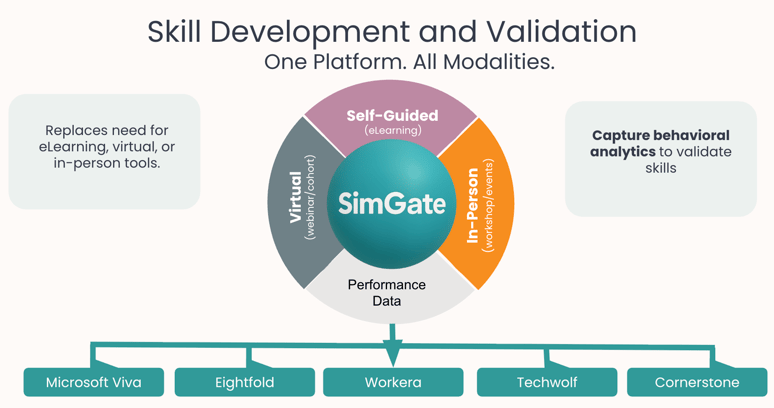
This automation creates competitive advantage. Organizations capturing behavioral proof at scale demonstrate learning impact with precision impossible through traditional methods.
Next Steps: Enterprise Scaling Without Complexity
Understanding AI skills validation transforms how L&D proves impact. You're no longer limited to hoping training works or relying on satisfaction surveys. Technology now captures behavioral proof automatically, creating leading indicators executives need to invest in learning as competitive advantage.
Want to watch the whole series?
Part I, "The L&D Breakthrough Moment: Proving Learning Impact," provided key strategies that enable L&D leaders to prove that learning creates measurable business impact. Watch the Replay of Part I.
Part II, "AI-Powered Skills Validation: The Technology That Proves Performance," demonstrates the AI technology capturing behavioral proof automatically at scale. Watch the Replay of Part II.
Part III, "AI-Powered Enterprise Scaling: Your Integrated Technology Advantage," reveals how to scale validation enterprise-wide without vendor complexity. Watch the Replay of Part III.